Cloud Skin vs. Glass Skin: K-Beauty Trend Guide 2026
Cloud skin or glass skin? I tested both K-beauty finishes for 30 days in Seoul. Here's the routine, products, and decision framework for 2026.

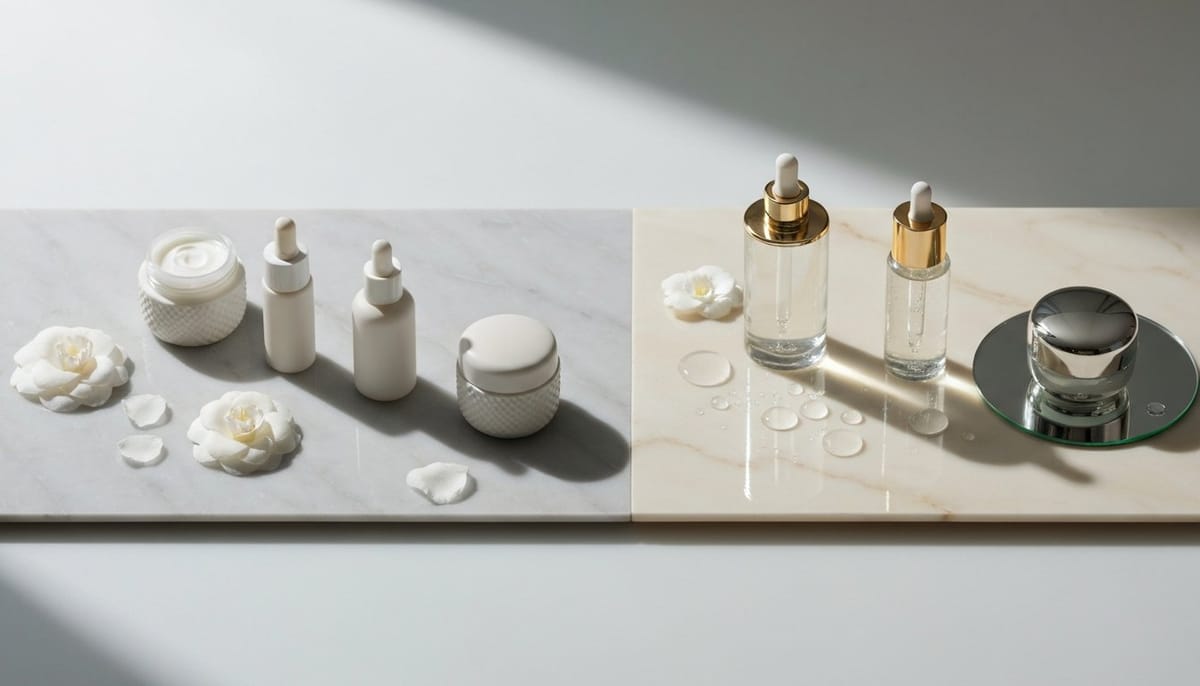
Cloud skin or glass skin? The short answer: glass skin is the high-shine, mirror-finish K-beauty original — best for dry to normal skin in humid climates. Cloud skin is the soft, diffused, "blurred-from-within" matte-satin finish that's quietly winning 2026 — better for oily, combination, and pore-prone skin. I've been wearing both on alternating weeks for the last 30 days here in Seoul, and the difference comes down to four things: finish, hydration ceiling, climate fit, and how long they actually last on your face.
I'm Mina Park, editor in chief at The Glow Pick. Cloud skin started showing up in my Pinterest feed in late 2025, then on Korean actresses' off-duty shots, and by this spring it's the look every K-beauty brand is suddenly building products for. But the marketing has gotten ahead of the explanation, so let's fix that. Below is the decision framework I wish someone had handed me — including the comparison table, the exact 4-step routines, and the K-beauty products I'd actually recommend for each finish.
What Exactly Is Cloud Skin?
Cloud skin is a soft, diffused, satin-matte finish where pores look optically blurred and the skin appears lit from within rather than reflective on the surface. Think of it as glass skin's quieter sister — still hydrated, but the dewiness is layered under the skin instead of sitting on top. The Korean term you'll see in beauty magazines is 구름 피부 (gureum pibu), literally "cloud skin," and it gained traction in late 2025 when Korean actresses started showing up on red carpets without the wet-look highlight that defined 2018–2024.
Three things make a face read as cloud skin: optically blurred pores (usually from finely milled niacinamide or silica primers), an even, low-level luminosity across the cheekbones and forehead instead of focused highlight points, and a soft satin finish that catches light without throwing it back. Cloud skin tends to photograph cooler — there's a hush to it.
What Exactly Is Glass Skin?
Glass skin is the iconic K-beauty look popularized around 2017–2018: a translucent, mirror-clear, intensely hydrated finish where the skin reflects light like polished glass. It's built on a foundation of layered hydration (toners, essences, ampoules, serums), barrier strengthening, and a visible sheen. If cloud skin is satin, glass skin is silk. If you want the deep version of how to actually get there, our complete glass skin routine guide walks through the 10 layers used by Korean estheticians.
The look depends on three things: barrier integrity (no flaking, no rough patches), high water content in the upper epidermis (held by ingredients like hyaluronic acid, snail mucin, beta-glucan), and a final occlusive layer that traps that water and creates the mirror finish. It's beautiful, but it's also a lot of product. And in humidity above 70%, glass skin can tip from luminous to slick within an hour.
Cloud Skin vs Glass Skin: The Side-by-Side Comparison
Here's the breakdown I keep coming back to when readers ask which one to commit to. I tested both finishes for 14 days each, photographed in the same light at hour 1, hour 4, and hour 8, on combination skin in Seoul's spring climate (60–75% humidity).
| Attribute | Cloud Skin | Glass Skin |
|---|---|---|
| Finish | Soft satin, diffused | Mirror, dewy, reflective |
| Best skin type | Combination, oily, pore-prone | Dry, normal, dehydrated |
| Best climate | Humid, hot, transitional seasons | Dry, cold, low-humidity indoors |
| Hydration layers | 3–4 lightweight | 6–10 layered |
| Hero ingredients | 4% niacinamide, beta-glucan, polyglutamic acid, silica | Hyaluronic acid, 96% snail mucin, ceramides, squalane |
| Hold time | 8–10 hours | 4–6 hours before retouching |
| Effort level | Low–medium (4 steps) | Medium–high (7–10 steps) |
| Photographs | Soft, editorial, cool-toned | Bright, reflective, warm-toned |
| Price range | $45–$95 starter set | $80–$160 starter set |
The headline finding from my 30-day test: cloud skin held its finish 2–3 hours longer than glass skin in 70%+ humidity, which matters if you're commuting, working in an air-conditioned office, then heading outside. Glass skin photographed gorgeously in low-humidity studio light but went slick on the T-zone around hour 4 of a normal Seoul workday.
Which K-Beauty Trend Is Right for Your Skin?
Skip the trend cycle and pick by skin type and climate. Here's the framework I give friends.
Choose cloud skin if you have:
Combination, oily, or breakout-prone skin. Visible pores on the nose, cheeks, or forehead. Skin that gets shiny by lunchtime even on a "good" day. You live somewhere humid year-round (Singapore, Tokyo summer, southern US, Seoul July–August), or you're wearing makeup for 8+ hours and need it to hold without retouching. You like a "no-makeup makeup" finish where the goal is even-toned skin, not visible product.
Choose glass skin if you have:
Dry, normal, or dehydrated skin. Skin that looks dull or shows fine lines by mid-afternoon. You live in a dry climate (LA, London winter, Korean winter at 30% humidity) or spend most of your day indoors with strong air conditioning or heating. You love the K-beauty ritual of layered products and have 8–10 minutes for a proper routine morning and night. You're going for a striking, photographable, "what's-her-secret" finish for events or content.
Choose both, alternating, if:
You're in transitional seasons (spring, fall) or your skin shifts between dry and oily depending on stress, sleep, and cycle. Most of my readers in their late 20s to 40s end up here — glass skin in dry winter months, cloud skin from May through September. Your barrier will thank you for the rotation; over-layering hyaluronic acid can paradoxically dehydrate skin in humid weather (it pulls water from the deeper dermis when the air is too saturated to give any up).
The Cloud Skin 4-Step Routine
This is the routine I've been running for 14 days now. Total time: 4 minutes. Total product cost (starter set): around $52.
Step 1 — Gentle low-pH cleanser. A non-stripping cleanser at pH 5.5 keeps the barrier intact. I use a rice-bran or amino-acid based cleanser. Skip foam cleansers if your skin runs combination — they over-strip and trigger rebound oil within hours. (Our roundup of best Korean cleansers ranks 10 by skin type.)
Step 2 — Niacinamide serum (4–5%). This is the cloud-skin engine. A 4% niacinamide serum reduces apparent pore size, regulates sebum, and creates the diffused light-reflection that makes pores look optically blurred. Applied to slightly damp skin, pat in 3–4 drops. Wait 60 seconds. Our deep-dive on niacinamide in Korean skincare covers why 4% beats 10% for sensitive skin.
Step 3 — Lightweight gel moisturizer with beta-glucan or polyglutamic acid. Cloud skin needs hydration that absorbs into the skin, not sits on it. Beta-glucan holds water 3x deeper than hyaluronic acid and doesn't create surface stickiness. Pat — never rub — to avoid disturbing the niacinamide layer.
Step 4 — SPF 50+ with a satin or matte finish. The final step is non-negotiable. A Korean SPF with a soft-focus or matte-finish formula (most modern K-beauty SPFs use silica or rice bran for blur) locks in the cloud finish all day. Avoid heavy chemical SPFs that finish glossy — those will fight your routine.
The Glass Skin 7-Step Routine
Glass skin takes more product and more patience. About 8 minutes morning and night, with a starter set running $90–$140.
Step 1 — Oil-based cleanser (PM only) followed by a gel cleanser. Double cleansing is essential — glass skin shows every leftover residue.
Step 2 — Hydrating toner, applied with damp hands in 3–5 layers. This is the "7-skin method." Each layer is patted in until absorbed before the next. Most foundational step.
Step 3 — Essence with snail mucin or fermented yeast. Snail mucin (96% concentration) is the gold standard for glass skin because it contains glycoproteins that hold water in the upper epidermis without occlusion. See our snail mucin guide for which formulas actually use 96% versus marketing levels.
Step 4 — Hyaluronic acid serum. Multi-molecular HA (at least 3 weights) is what creates the visible plumping that defines glass skin's mirror reflection.
Step 5 — Ampoule or treatment. A peptide or barrier-repair ampoule fills any micro-cracks that would otherwise scatter light unevenly.
Step 6 — Ceramide-rich moisturizer. Ceramides 1, 3, and 6-II rebuild the lipid bilayer that holds in everything you just applied. This is what creates the "seal" for the glass effect.
Step 7 — Dewy-finish SPF or facial oil (1–2 drops, AM only). The final mirror layer. A glow-finish K-beauty SPF or, in evenings, 1–2 drops of squalane or rosehip oil pressed into the cheekbones.
Best Korean Products for Cloud Skin (2026)
Tested, photographed at hour 4 and hour 8, ranked by how well they held the satin-matte finish without flattening into dullness.
1. The Ordinary–style 4% Niacinamide Serum (Korean alternatives): SKIN1004 Madagascar Centella Hyalu-Cica Brightening Serum or Numbuzin No. 5 Vitamin Niacinamide Concentrate. Both pair niacinamide with calming centella, which prevents the flushing some readers get from niacinamide alone.
2. Beauty of Joseon Glow Serum (Propolis + Niacinamide). 60% propolis extract plus 2% niacinamide — adds a soft golden cast under the satin finish that flatters most undertones. Around $17 on Amazon.
3. Anua Heartleaf 77% Soothing Toner. Calming, non-occlusive, prevents the redness flare-ups that can break the cloud illusion. Heartleaf (houttuynia cordata) is the rising star K-beauty ingredient for sensitive-oily skin.
4. Round Lab 1025 Dokdo Cream or Birch Juice Moisturizing Sun Cream. The Birch Juice SPF specifically — its satin-matte finish is what most K-beauty editors quietly use under their "cloud skin" Instagram posts.
5. Sulwhasoo Essential Comfort Balancing Water (or any Korean galactomyces-fermented essence). For evening cloud skin prep, fermented essences refine pore appearance over 4–6 weeks.
For a broader survey across categories, our best Korean skincare products of 2026 rounds up 20 picks.
Best Korean Products for Glass Skin (2026)
The classics earn their reputation. These are the formulas Korean beauty editors actually keep on their bathroom shelves.
1. COSRX Advanced Snail 96 Mucin Power Essence. The non-negotiable. 96% snail secretion filtrate, pH 5.5, the formula every glass-skin tutorial begins with. Around $25 on Amazon.
2. Laneige Cream Skin Refiner or Essential Power Skin Refiner. Hybrid toner-cream that delivers 7-skin hydration in fewer layers — a shortcut for when you don't have 8 minutes.
3. Beauty of Joseon Hanbang Hyaluronic Acid Boosting Toner. Multi-molecular HA with traditional Korean herbal extracts. The plumping is visible by hour 1.
4. Missha Time Revolution The First Treatment Essence Rx. Often called "the Korean SK-II" — fermented bifida ferment lysate that creates the bouncy, dense quality unique to glass skin.
5. Belif The True Cream Aqua Bomb or Laneige Water Bank Blue Hyaluronic Cream. The final ceramide-rich moisturizer that creates the mirror seal.
Our companion guide 12 best Korean moisturizers ranks the top picks across skin types.
Are Cloud Skin and Dolphin Skin the Same Thing?
Almost — but not quite. Both are post-glass-skin trends emphasizing diffused light over mirror reflection. The difference is hydration ceiling: dolphin skin still aims for plump, bouncy hydration with a slight bounce-back when you press on the cheekbone. Cloud skin pushes the finish further toward satin-matte and prioritizes pore blur over plumpness. Think of it as a spectrum: glass skin → dolphin skin → cloud skin, with hydration decreasing and pore blur increasing as you move along. Our deep-dive on dolphin skin covers the middle category in detail.
Common Cloud Skin and Glass Skin Mistakes
Four mistakes I see consistently in reader photos, regardless of which finish you're going for.
Skipping SPF. Both finishes depend on smooth, even-toned skin. Sun damage creates micro-pigmentation that scatters light unevenly, breaking both glass and cloud effects within weeks. Non-negotiable.
Over-exfoliating. AHAs and BHAs more than 2x weekly thin the stratum corneum. A thin barrier cannot hold the hydration glass skin needs, and shows redness that breaks the cloud-skin satin uniformity.
Wrong moisturizer for climate. A heavy ceramide cream in 75% humidity gives you slick skin, not glass skin. A lightweight gel in 30% winter humidity dehydrates you, ruining cloud skin. Match the formula weight to your environment, not to the trend.
Layering products too fast. Each layer needs 30–60 seconds to absorb. Stacking products wet-on-wet creates pilling and uneven absorption — visible as patches of dewy skin next to flat skin, which is the opposite of either trend's even finish.
Frequently Asked Questions
How long until cloud skin or glass skin actually shows up?
For glass skin: most readers see results within 1 week of consistent layered hydration, full transformation by week 4 as the barrier rebuilds. For cloud skin: niacinamide pore-refining effects are visible by day 10, full satin-matte finish by week 6. Skin cell turnover takes about 28 days in your 20s and 40+ days after 35, so meaningful visible change happens on a monthly timeline, not a weekly one.
Can I do cloud skin if I have very dry skin?
Yes, but adapt the routine. Add a lightweight ceramide serum after step 2 (niacinamide), and use a slightly richer gel-cream at step 3 instead of a pure gel. The cloud finish still works — you'll just need an extra hydration boost underneath. Avoid foaming cleansers entirely.
Does glass skin work for over-40 skin?
Beautifully, with one swap: replace pure hyaluronic acid with polyglutamic acid plus peptides at step 4. Mature skin holds water differently — polyglutamic acid bonds it more efficiently to skin proteins, which translates to the same plump glass-skin finish without the dehydration rebound that pure HA can cause in low humidity.
Which trend will K-beauty actually keep promoting in 2026?
Both, but cloud skin is gaining commercial momentum. Five major Korean brands launched cloud-skin-specific lines between October 2025 and February 2026 (Numbuzin, SKIN1004, Round Lab, Laneige, and Beauty of Joseon). Glass skin remains the foundation people learn first, then most longtime K-beauty users layer in cloud-skin techniques as their preferences mature.
Can I wear makeup over cloud skin or glass skin?
Cloud skin holds makeup better — its satin base grips foundation and concealer without breaking. Glass skin's high-shine finish often makes powder products slide; if you want the dewy look under makeup, use a hydrating cushion foundation or skin tint, never a matte powder formula. For glass skin specifically, our BLACKPINK glass skin routine walks through the 10-minute version that pros use under stage makeup.
What's the budget version of each trend?
Cloud skin starter under $50: COSRX Centella Cleanser ($12) + The Ordinary Niacinamide 10% + Zinc 1% ($7) + COSRX Oil-Free Ultra-Moisturizing Lotion ($18) + Beauty of Joseon Relief Sun ($17). Glass skin starter under $80: Banila Co Clean It Zero Cleansing Balm ($22) + COSRX Snail 96 Essence ($25) + Beauty of Joseon HA Boosting Toner ($17) + Belif Aqua Bomb ($38) — total $102 actually, but rotate the moisturizer to a smaller-size first to test fit.
The Bottom Line
Cloud skin and glass skin are both legitimate, beautiful K-beauty finishes — they're just engineered for different climates, skin types, and moods. Glass skin is the architectural achievement: layered, ritualistic, photogenic. Cloud skin is the lived-in version: lower effort, higher pore blur, longer hold in real-world conditions. Neither is "better." The right one is the one your skin can hold for 8 hours without fighting you.
If you're new to K-beauty, start with glass skin in colder months — the layering teaches you what your skin actually needs. Once you understand your barrier, transition to cloud skin in summer or anytime humidity climbs above 65%. Most of the Korean beauty editors I know rotate seasonally and never commit to just one. Your skin is allowed to change its mind.
By Mina Park, Editor in Chief, The Glow Pick. Tested April 2026 in Seoul, with 14 days each on glass skin and cloud skin protocols. Skin: combination, age 32, fair-medium with warm undertone.