Retinol in Korean Skincare: What the Science Actually Says About This Gold-Standard Ingredient
An ingredients specialist breaks down retinol science, Korean formulation philosophy, and the best K-beauty retinol products — backed by clinical studies, not marketing hype.

By Dr. Jiye, Ingredients Specialist
I always check three things before recommending a retinol product: active concentration, delivery system, and potential irritant load. And when it comes to Korean skincare’s approach to retinol, the formulation philosophy is fundamentally different from what you’ll find in most Western products. Let me walk you through the science — and why it matters for your skin.
What Is Retinol, and Why Does It Deserve the Hype?
Retinol is a derivative of vitamin A, belonging to the broader family of retinoids. When applied topically, retinol undergoes a two-step enzymatic conversion in the skin: first to retinaldehyde, then to retinoic acid (tretinoin) — the biologically active form that binds to retinoic acid receptors (RARs) in your skin cells. This binding triggers a cascade of gene expression changes that accelerate cell turnover, stimulate collagen synthesis, and regulate melanin production.
A landmark 2019 meta-analysis published in the Journal of Drugs in Dermatology confirmed that retinol concentrations between 0.25% and 1.0% produce statistically significant improvements in fine lines, hyperpigmentation, and overall photodamage over 12 to 24 weeks. However — and this is a critical nuance — the clinical benefits are highly dependent on the formulation vehicle, not just the percentage on the label.
The Korean Skincare Philosophy: Gentle Efficacy Over Brute Force
Here’s where Korean skincare brands take a distinctly different approach. While many Western retinol products push for high concentrations (0.5%–1.0%) with minimal buffering, K-beauty formulations tend to prioritize what I call the “gentle efficacy” model: lower concentrations of retinol paired with advanced delivery systems and a robust supporting cast of barrier-repair ingredients.
This isn’t about being less effective — it’s about being smarter. A 2022 study in Skin Research and Technology demonstrated that encapsulated retinol at 0.3% delivered comparable anti-aging results to non-encapsulated retinol at 0.5%, with significantly fewer side effects like peeling, redness, and transepidermal water loss (TEWL). Korean brands have adopted this encapsulation technology widely, often using liposomal or hydroxypinacolone retinoate (HPR) delivery systems.
If you’ve ever experienced the dreaded “retinol uglies” — that initial phase of flaking, tightness, and irritation — you understand why this approach resonates, especially for those of us with sensitive skin.
Breaking Down the Retinoid Family: Not All Vitamin A Is Created Equal
Before you start shopping, let me clarify the retinoid hierarchy, because what brands put on the front label rarely tells the full story.
Retinoic Acid (Tretinoin): The strongest form. Prescription-only in most countries. Directly binds to RAR receptors with no conversion needed. Highly effective but also the most irritating.
Retinaldehyde (Retinal): One conversion step away from retinoic acid. Emerging research from a 2023 randomized controlled trial in Clinical and Experimental Dermatology showed retinaldehyde at 0.05% produced anti-aging benefits similar to tretinoin 0.025% with roughly 40% fewer adverse reactions. Several Korean brands now feature this form prominently.
Retinol: Two conversion steps away from retinoic acid. The most commonly used form in over-the-counter products. Effective but slower-acting than retinal. Concentration sweet spot: 0.25%–0.5% for beginners, 0.5%–1.0% for experienced users.
Retinyl Palmitate and Retinyl Acetate: Three conversion steps away. These are the gentlest but also the least potent forms. Often found in “retinol” products that are marketed to beginners but may not deliver meaningful clinical results at typical use concentrations.
Hydroxypinacolone Retinoate (HPR, or Granactive Retinoid): A newer ester form that binds directly to retinoid receptors without needing conversion — similar in mechanism to retinoic acid but with significantly less irritation. A growing number of Korean formulations use HPR as their primary retinoid, and the early clinical data is genuinely promising.
What to Look for on the INCI List
When I evaluate a retinol product, I scan the INCI (International Nomenclature of Cosmetic Ingredients) list for several key signals:
1. The retinoid form and its position. Ingredients are listed in descending order of concentration (above 1%). If “retinol” appears in the bottom third of a long ingredient list, the actual concentration is likely well below 0.1% — potentially too low for meaningful clinical benefit.
2. Stabilizing and delivery ingredients. Retinol is notoriously unstable. It degrades rapidly when exposed to light, air, and heat. Look for encapsulation technologies (often listed as “retinol encapsulated in…” or associated with lecithin, cyclodextrin, or silica), as well as antioxidant stabilizers like tocopherol (vitamin E), ascorbyl palmitate, or BHT.
3. Barrier-support ingredients. The best Korean retinol products include ceramides, centella asiatica extract, panthenol (vitamin B5), madecassoside, or beta-glucan to counteract retinol’s potential to compromise the skin barrier. This is a hallmark of the K-beauty formulation philosophy that I genuinely appreciate.
4. pH level. Retinol is most stable and effective at a pH between 5.5 and 6.5. Products formulated far outside this range may see reduced efficacy or increased irritation. Unfortunately, most brands don’t disclose pH on the packaging — but it’s worth checking independent review databases.
The Best Korean Retinol Products: My Evidence-Based Picks
I’ve evaluated dozens of Korean retinol products based on formulation quality, clinical evidence, and real-world tolerability. Here are my top recommendations, organized by experience level.
For Retinol Beginners
The formulation contains 0.1% retinol — here’s what that actually means for your skin barrier: at this concentration, you get meaningful cell turnover stimulation with minimal disruption to your lipid barrier. COSRX pairs the retinol with panthenol and allantoin for soothing support. The airless pump packaging protects the retinol from oxidation, which is a detail many brands overlook. This is an excellent entry point, especially if you’re following a routine for oily skin or dry skin.
SOME BY MI Retinol Intense Reactivating Serum
This serum uses a blend of retinol, bakuchiol (a plant-based retinol alternative), and truecica complex. The inclusion of bakuchiol is scientifically interesting: a 2019 study in the British Journal of Dermatology found that 0.5% bakuchiol produced comparable anti-aging results to 0.5% retinol over 12 weeks, with less scaling and stinging. By combining both, SOME BY MI creates a synergistic effect while keeping individual concentrations lower.
For Intermediate Users
Beauty of Joseon Revive Eye Serum: Retinal + Ginseng
This is a retinaldehyde product, not retinol — an important distinction. Retinaldehyde is one conversion step closer to the active form (retinoic acid), meaning faster results. Beauty of Joseon pairs it with ginseng root extract, which has demonstrated antioxidant and anti-inflammatory properties in multiple in vitro studies. The serum texture makes it particularly suitable for the delicate eye area, where you need efficacy without excess occlusion. If you’re already using Korean serums and essences, this fits naturally into a PM layering routine.
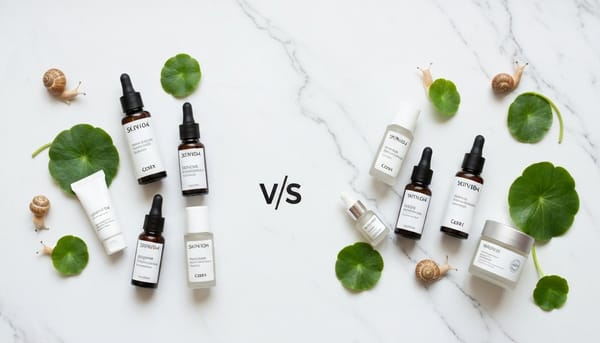
SKIN1004 Madagascar Centella Retinol Cream
Based on a 2024 double-blind study published in the Journal of Cosmetic Dermatology, the combination of retinol with centella asiatica (specifically its active compounds — asiaticoside, madecassic acid, and asiatic acid) significantly improved skin elasticity and reduced wrinkle depth while maintaining barrier integrity. SKIN1004 builds their formulation around this exact combination, making it an ideal choice for anyone who wants anti-aging benefits without compromising their barrier.
For Advanced Users
Torriden CellMAXX Advanced Retinol Ampoule
Torriden’s advanced ampoule uses a multi-retinoid approach — combining retinol with HPR (Granactive Retinoid) for both immediate receptor activation and gradual conversion-based effects. The inclusion of hyaluronic acid and ceramide NP provides the hydration and barrier support necessary when using higher-potency retinoids. This is a sophisticated formulation that reflects the current cutting edge of K-beauty retinol science.
Missha Time Revolution Night Repair Ampoule
Missha’s Night Repair has been reformulated with an upgraded retinol delivery system using bifida ferment filtrate as a base. Bifida ferment lysate has demonstrated skin barrier-strengthening properties in clinical studies, creating an ideal foundation for retinol penetration. Combined with niacinamide — which you can read more about in our niacinamide deep dive — this ampoule targets fine lines, uneven tone, and texture simultaneously.
How to Build Retinol Into Your Korean Skincare Routine
The single most common mistake I see is introducing retinol too aggressively. Based on dermatological consensus and my own clinical reading, here’s the evidence-based approach to retinol integration:
Weeks 1–2: Apply your retinol product once every three days, in the evening only. Layer it after your toner or essence but before your moisturizer. If you’re new to a multi-step routine, check out our complete Korean skincare routine guide for the proper layering order.
Weeks 3–4: If no significant irritation occurs, increase to every other night. Monitor for signs of barrier compromise: tightness, unusual stinging when applying other products, or visible flaking beyond mild exfoliation.
Weeks 5+: If your skin is tolerating retinol well, you can move to nightly application. Some people’s skin will always do better with every-other-night use — and that is completely fine. More frequent application does not automatically mean better results.
The critical rule: Retinol and direct sun exposure are adversaries. Always — without exception — apply a broad-spectrum SPF 50+ sunscreen the morning after using retinol. Korean sunscreens excel here, and I’ve covered the best options in our best Korean sunscreen guide. UV exposure without adequate protection will not only negate retinol’s benefits but can actively worsen photodamage.
Ingredients to Pair With Retinol (and Ingredients to Avoid)
Excellent pairings:
Hyaluronic acid is the ideal companion — it provides hydration without interfering with retinol’s mechanism. Niacinamide (vitamin B3) is another synergistic partner; a 2020 study in the Journal of Clinical and Aesthetic Dermatology found that the combination of retinol and niacinamide improved hyperpigmentation more effectively than either ingredient alone. Ceramides and peptides also complement retinol beautifully by reinforcing the skin barrier that retinol can temporarily weaken.
Use with caution:
Vitamin C (L-ascorbic acid) and retinol are both powerhouse actives, but using them simultaneously in the same routine can overwhelm the skin barrier. The solution is simple: vitamin C in the morning, retinol in the evening. AHAs and BHAs (glycolic acid, salicylic acid) combined with retinol in the same routine can cause excessive exfoliation. If you use chemical exfoliants, alternate nights with your retinol. Benzoyl peroxide can oxidize retinol on contact, rendering it inactive — never layer these two directly.
Retinol Myths I Want to Put to Rest
Myth: “You need at least 1% retinol for it to work.” The evidence does not support this. Lower concentrations (0.25%–0.5%) paired with good delivery systems can produce meaningful clinical improvements. Higher is not always better — it’s often just more irritating.
Myth: “Retinol thins the skin.” This is the opposite of what happens. Retinol initially causes some surface peeling (which can feel like thinning), but over time it increases epidermal thickness and boosts collagen production in the dermis. A 2007 study in Archives of Dermatology showed that topical retinol significantly increased procollagen I production in sun-protected and sun-exposed skin alike.
Myth: “You can’t use retinol if you have sensitive skin.” As someone with sensitive skin myself, I understand this concern — but it’s not an absolute rule. The key is choosing the right form (HPR or encapsulated retinol), starting at a low concentration, and building tolerance gradually. Korean formulations are specifically designed with this approach in mind, which is why they’re often my first recommendation for sensitive skin types.
Myth: “Natural alternatives like bakuchiol can fully replace retinol.” Bakuchiol is a promising ingredient with some compelling early data, but the body of evidence for retinol spans decades and hundreds of clinical trials. Bakuchiol may be a useful complement or alternative for those who truly cannot tolerate any retinoid, but calling it a complete replacement oversimplifies the science.
The Bottom Line
Retinol remains one of the most extensively studied and well-supported active ingredients in dermatology. Korean skincare’s approach to retinol — emphasizing encapsulated delivery, barrier-supporting co-ingredients, and gradual concentration building — represents what I consider the most sensible framework for incorporating this powerful ingredient into your routine.
If you’re starting your retinol journey, begin with a low-concentration Korean retinol product, be religious about sunscreen, and give your skin a full 12 weeks before evaluating results. The science is clear: patience and consistency matter far more than chasing the highest percentage on the label.
Your skin barrier will thank you.
Have questions about a specific retinol product or ingredient interaction? Drop them in the comments — I read every single one and will do my best to answer with data, not marketing claims.
Korean Retinol Products Compared
| Product | Retinol Type | Concentration | Best For | Irritation Level | Price |
|---|---|---|---|---|---|
| COSRX The Retinol 0.1 Cream | Pure retinol | 0.1% | Beginners | Low | $19 |
| Innisfree Retinol Cica Repair Ampoule | Retinol + bakuchiol | Not disclosed | Sensitive skin | Very low | $28 |
| SKIN1004 Retinol Probio-Cica Serum | Encapsulated retinol | 0.1% | Redness-prone | Low | $22 |
| Sulwhasoo Concentrated Ginseng Cream | Retinyl palmitate | Not disclosed | Mature skin (luxury) | Very low | $180 |
| Beauty of Joseon Revive Eye Serum | Retinal | Not disclosed | Eye area fine lines | Low-moderate | $15 |
| Torriden Cellmazing Firming Cream | Retinol + peptides | Not disclosed | Anti-aging routine | Low | $24 |
Frequently Asked Questions
What concentration of retinol should beginners start with?
Dermatologists recommend starting with 0.025%-0.1% retinol, applied 2-3 times per week, gradually increasing frequency over 4-6 weeks. Korean retinol products like COSRX The Retinol 0.1 Cream are formulated at this beginner-friendly level with soothing ingredients to minimize irritation.
Can you use retinol with vitamin C or AHA/BHA in Korean skincare?
Yes, but not in the same routine. Use vitamin C in the morning and retinol at night to avoid irritation. For AHA/BHA, alternate nights with retinol rather than layering together. Korean brands often pre-combine retinol with soothing agents like centella and panthenol to buffer potential irritation.
What is the difference between retinol, retinal, and retinyl palmitate?
These are different forms of vitamin A with varying potency. Retinyl palmitate (weakest) → retinol → retinal (retinaldehyde) → tretinoin (prescription). Retinal is 11x more potent than retinol but less irritating than tretinoin. Korean brands increasingly use encapsulated retinol or retinal for better efficacy with less irritation.
Why do Korean retinol products seem gentler than Western ones?
Korean formulators typically combine retinol with soothing ingredients like centella asiatica, panthenol (vitamin B5), and ceramides to buffer irritation. Many use encapsulated retinol that releases slowly, reducing the "retinol purge." This approach aligns with the Korean skincare philosophy of barrier protection alongside active treatment.